
Lazy eye (amblyopia) in children — what it is and how to treat it
- #vision therapy
- #amblyopia
- #children's vision
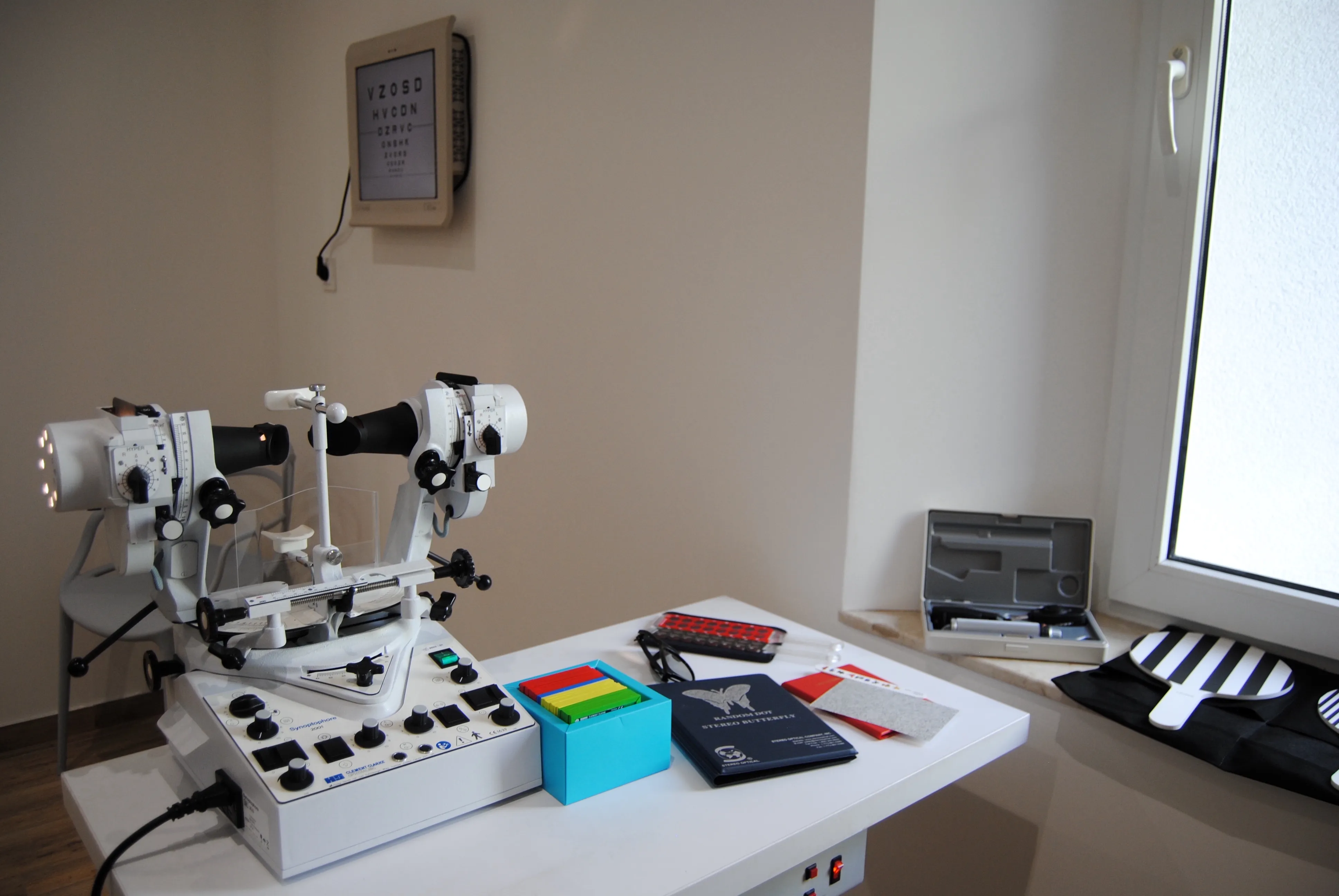
“Lazy eye” sounds harmless, as if the eye were simply slacking off. In reality amblyopia is one of the most common causes of reduced vision in one eye in children — and, at the same time, a problem that responds well to treatment when caught early. That’s exactly why, as an orthoptist, I keep repeating: let’s not wait.
What is amblyopia?
Amblyopia is reduced visual acuity in one eye (rarely both), even though the eye itself is healthy and well corrected with glasses. The problem lies in the development of vision in the brain: during childhood the brain “learns” to use the image from both eyes. If the image from one eye is poorer or confusing, the brain begins to suppress it — and that eye never develops full acuity.
Where does it come from?
The most common causes are:
- strabismus (a squint) — the brain suppresses the image from the deviating eye to avoid double vision,
- anisometropia — a large difference in refractive error between the eyes; one eye sees clearly, the other is constantly blurred,
- an obstruction in the visual axis — for example a drooping eyelid or a congenital cataract.
Amblyopia can be sneaky because the child doesn’t complain — the other eye “compensates”, so everything seems fine day to day. That’s why screening and a first visit at the right age matter so much.
Why does timing matter so much?
The development of vision has its window. A pooled analysis of studies showed that amblyopia responds better to treatment in children under 7 years old. That doesn’t mean older children can’t be helped — in a study of children aged 7–17, treatment also improved visual acuity, especially in those who hadn’t been treated before. The takeaway is simple: the earlier the better — but it’s always worth trying.
How is amblyopia treated?
The treatment plan is individual, often in cooperation with an ophthalmologist. The pillars are:
Spectacle correction
This is the foundation — first the amblyopic eye needs a sharp image. Correction alone can already be a source of improvement.
Patching (occlusion)
Covering the stronger eye “forces” the brain to work with the weaker one. Importantly, in studies 2 hours of daily patching (combined with near visual activities) produced improvement similar to 6 hours in moderate amblyopia — less demanding schedules can be just as effective for the child.
Pharmacological penalisation (atropine)
Instead of a patch, the image in the stronger eye can be blurred with atropine drops. In studies atropine and patching produced improvement of similar magnitude — both are suitable to start treatment. Atropine is used only on a doctor’s order and under supervision.
Vision therapy and digital methods
Binocular vision exercises help the eyes “make peace” and reduce suppression. There is also growing interest in dichoptic therapy (a separate image for each eye) — in a randomised trial, watching specially modified videos through headset glasses improved the amblyopic eye’s acuity more than correction alone. You’ll find child-friendly versions of such tasks in our vision games and exercises.
Children don’t “grow out of” amblyopia, and it doesn’t pass on its own. But with early diagnosis and consistent treatment, good vision can very often be restored.
Who treats it?
Diagnosis and therapy for strabismus and amblyopia are handled by an orthoptist — often together with an ophthalmologist and optometrist (I wrote about the differences between specialists in this post). Convergence and accommodation exercises can also be very helpful in therapy.
If you suspect a lazy eye in your child, or there’s a family history of squint or amblyopia, book an orthoptic examination. Get in touch — the earlier we start, the greater the chance of full improvement.
Sources
- Repka MX, et al. (2003). A randomized trial of patching regimens for treatment of moderate amblyopia in children. Archives of Ophthalmology. PubMed
- Pediatric Eye Disease Investigator Group. (2002). A randomized trial of atropine vs patching for treatment of moderate amblyopia in children. Archives of Ophthalmology. PubMed
- Holmes JM, et al. (2011). Effect of age on response to amblyopia treatment in children. Archives of Ophthalmology. PubMed
- Scheiman MM, et al. (2005). Randomized trial of treatment of amblyopia in children aged 7 to 17 years. Archives of Ophthalmology. PubMed
- Xiao S, et al. (2022). Randomized Controlled Trial of a Dichoptic Digital Therapeutic for Amblyopia. Ophthalmology. PubMed