
A child's first eye examination — when and how often?
- #eye examination
- #children's vision
- #prevention
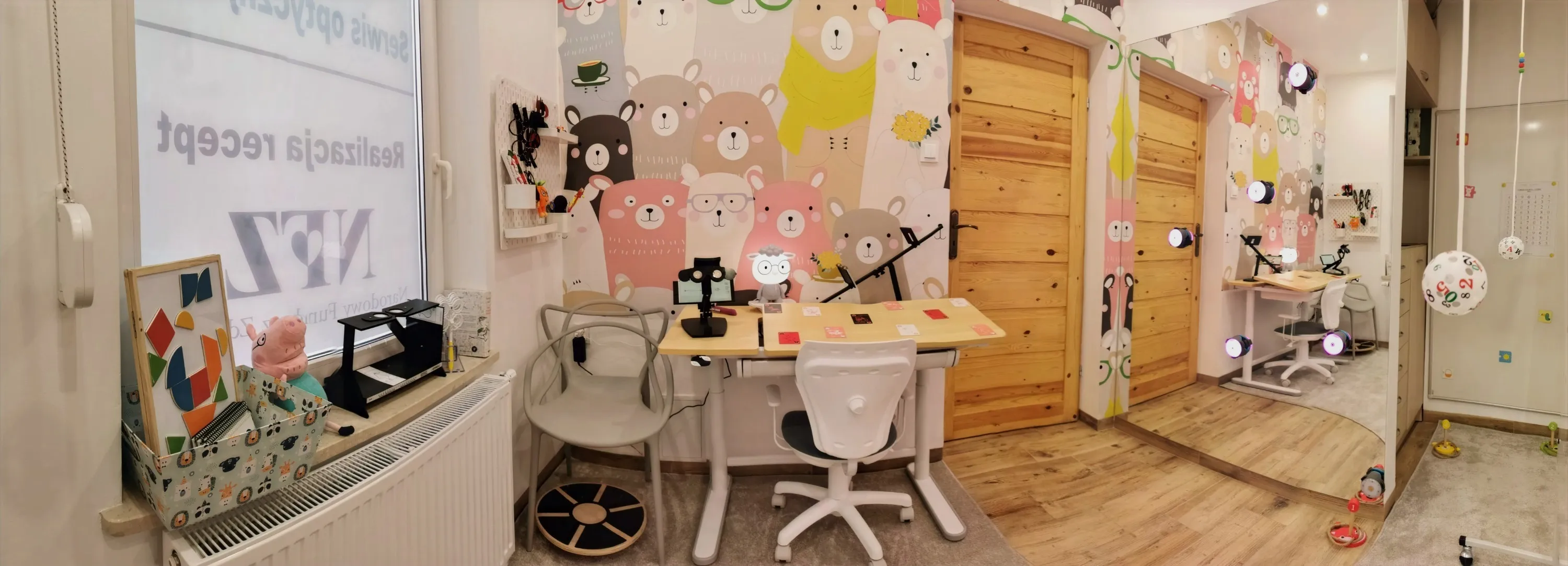
“But she sees fine, she doesn’t complain” — I hear this very often. The trouble is that a young child has nothing to compare with: if they’ve always seen things blurry, they take it as normal and won’t tell us anything is wrong. That’s why a first eye examination isn’t triggered by the child’s complaint, but by their age and prevention.
Why do children rarely signal a problem?
The visual system is still developing, and a child is brilliant at “compensating” — leaning in, squinting, relying on the better eye. Some conditions (such as amblyopia) don’t hurt and give no obvious symptoms, yet quietly limit the development of vision. Hence the important role of screening and scheduled visits.
When to plan the first examination?
Ophthalmology and paediatric society guidelines recommend assessing vision from the newborn period and repeating it at later stages. In practice, a sensible schedule looks like this:
- Newborn / infant — checking the red reflex and response to light (usually by a paediatrician or neonatologist), especially with prematurity or a family history.
- Around 6–12 months — screening if anything is of concern (a squint, nystagmus, a “wandering” eye).
- Around age 3 — a first fuller examination with a specialist, once the child can cooperate.
- Before starting school (ages 4–5) — a key moment to detect refractive error, strabismus and amblyopia before they start to hinder learning. The US expert panel (USPSTF) recommends screening at least once in every child aged 3–5 precisely to catch amblyopia and its risk factors.
Not sure what stage your child is at? Write to me — I’ll help you choose the right time.
How often to repeat it?
- children with no detected problems — a check-up usually every 1–2 years, and definitely before school and whenever new symptoms appear,
- children in glasses or after a diagnosis of a refractive error/squint/amblyopia — more often, as advised by the specialist; a child’s vision changes quickly.
Why do we care so much about early detection?
Because timing genuinely affects the treatment outcome. A pooled analysis of studies showed that amblyopia responds better to treatment in children under 7. The evidence report for the USPSTF, in turn, confirmed that available screening tests can flag preschoolers at increased risk of vision problems, and that treatment improves visual acuity. In other words: the earlier we catch a problem, the greater the chance of effective treatment and a better outcome.
Signs not to wait for an “appointment date”
- a squint or a “wandering” eye, tilting the head when looking,
- squinting, moving close to the TV, book or tablet,
- frequent eye rubbing, watering, headaches,
- losing their place when reading, reluctance towards near tasks,
- a white reflex in the pupil in photos (instead of red) — then see an ophthalmologist urgently.
What is an examination like for a child?
Calm and fun — with the youngest I rely on pictures, play and short tasks, without pressure. I check visual acuity, refractive error, eye alignment and teamwork and — if needed — binocular vision functions. How to prepare your child for the visit is described in the For patients section, and the full scope is in the services.
A first eye examination isn’t “a last resort when something is wrong” — it’s part of prevention, like a well-child check with the paediatrician.
Would you like to book your child’s first eye examination? Get in touch — together we’ll look after their eyesight from the very start.
Sources
- US Preventive Services Task Force. (2017). Vision Screening in Children Aged 6 Months to 5 Years: Recommendation Statement. JAMA. PubMed
- Donahue SP, Nixon CN, et al. (2016). Visual System Assessment in Infants, Children, and Young Adults by Pediatricians. Pediatrics. PubMed
- Jonas DE, et al. (2017). Vision Screening in Children Aged 6 Months to 5 Years: Evidence Report and Systematic Review for the US Preventive Services Task Force. JAMA. PubMed
- Holmes JM, et al. (2011). Effect of age on response to amblyopia treatment in children. Archives of Ophthalmology. PubMed