
Convergence exercises — how to strengthen your eyes' teamwork
- #vision therapy
- #exercises
- #convergence
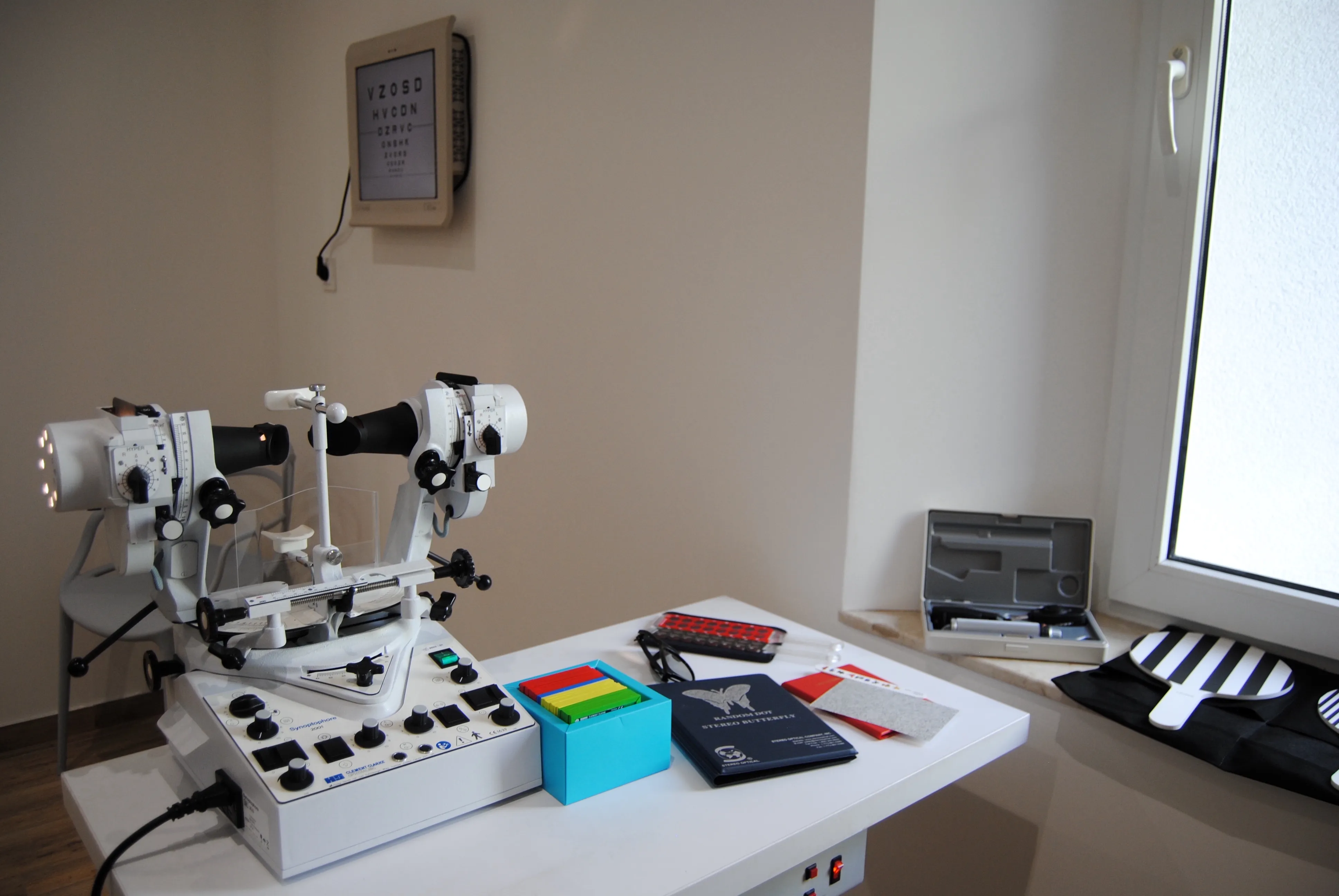
When we look at something up close — reading a book, writing in a notebook, checking a phone — our eyes have to turn slightly inward so that both lines of sight meet on the object. That ability is convergence. When it works smoothly, near work feels comfortable. When it falters, fatigue sets in and sometimes double vision appears.
What is convergence?
Convergence is the coordinated inward movement of both eyes that lets us keep a single, clear image of a nearby object. It relies on the extraocular muscles and a precise partnership between the brain and the eyes — which is why convergence problems are not “laziness”, but a visual function that can be trained.
Convergence insufficiency — how to spot it
The most common signs of convergence insufficiency (especially in school-age children):
- headaches and eye strain while reading,
- double vision or letters that “drift apart”,
- losing your place in a text, skipping words,
- squinting or covering one eye,
- reluctance to read or do near tasks,
- trouble concentrating at a desk.
If you recognise these signals in your child, it is worth having an orthoptic examination, which assesses, among other things, the range of convergence.
Convergence exercises
The exercises below are a safe starting point, but they should be selected and supervised by a specialist — their type, intensity and order depend on the examination results.
1. Pencil push-ups
Hold a pencil at arm’s length, at eye level. Slowly bring it towards your nose, keeping your gaze on the tip and trying to see one pencil. When you see two — stop and move back a few centimetres. Repeat a dozen or so times.
2. Brock string
A string with coloured beads. You place one end against your nose and fix the other in the distance. Looking at successive beads trains precise eye alignment and the ability to hold a single image at different distances. It is one of the most effective binocular-vision exercises.
3. Small-print card
Focusing on tiny letters brought closer to the face teaches you to maintain clarity and a single image under a strong convergence effort.
How often to practise?
The key is regularity, not length. It is usually better to practise briefly (5–10 minutes) every day than once a week for an hour. Exercises should be good fun for the child — no pressure, no fatigue.
Exercises are part of therapy, not the whole of it. The best results come from a plan built after a functional vision assessment and guided by a specialist.
When to see a specialist?
If the symptoms keep coming back, don’t wait — the sooner we begin vision therapy, the faster and more lasting the improvement in near-work comfort. During the visit I assess convergence, accommodation and binocular vision, then build an individual exercise plan.
You may also like the related post: Eye accommodation — how to improve and train focusing flexibility.
Questions, or would you like to book an examination? Get in touch.